Skip to content
The question came at the end of a long phone call, after the son had already asked about scheduling, about training, about how quickly someone could start.
“I know this sounds strange,” he said. “But what would she actually do? Like, all day. What does that look like?”
His mother was 84, living in Killarney, and had been receiving palliative care through her medical team for about three months. The family had been managing at home, mostly. His sister was doing overnights. He was doing weekends. Both of them were exhausted in a way that had stopped being about sleep.
They had been told that in-home care could help. Nobody had explained what that actually meant in practice.
It is one of the most common questions Calgary families ask, and one of the least often answered clearly. Understanding what a palliative caregiver does at home turns an abstract idea into something a family can picture, and picturing it is usually what makes the decision possible.
First, an important distinction
There are two different kinds of support that surround a person receiving palliative care at home, and families often blur them together.
The medical palliative team manages the clinical side. Pain and symptom management, medication adjustments, clinical assessments, coordination with specialists. This team is led by doctors and nurses.
The in-home caregiver supports everything else. Daily living, comfort, dignity, presence, and the practical running of a household during one of the hardest seasons a family will ever go through.
Both matter. They do different jobs. A palliative caregiver does not replace the medical team, and the medical team does not do what a caregiver does.
If the distinction between palliative care and hospice care is still unclear, our guide on palliative care vs hospice care for Calgary families explains it in detail.
Personal care with dignity
This is the most visible part of a caregiver’s work, and the part where skill matters more than families expect.
Bathing someone who is frail, in pain, or frightened requires a completely different approach than bathing someone who is simply older. Water temperature, positioning, pacing, privacy, and the ability to read discomfort before the person has to name it all become part of the work.
The same applies to dressing, grooming, oral care, and toileting. A skilled caregiver does these things in a way that protects dignity rather than eroding it. Many Calgary families say this is the single thing they were most anxious about and most relieved to hand over.
Incontinence care, when it becomes part of the picture, is handled without commentary or awkwardness. This is often the point at which a family caregiver reaches their limit, not from unwillingness, but because the relationship between an adult child and a parent makes it uniquely difficult.
Our personal care page explains more about what this kind of support involves day to day.
Comfort and positioning
For someone spending most of their time in a bed or a chair, small physical adjustments make an enormous difference to comfort.
A caregiver repositions gently and regularly to prevent pressure sores and ease stiffness. They adjust pillows, blankets, and support cushions. They notice when the sun has moved and the light is now in someone’s eyes. They notice when the room has grown too warm or too cold.
They also manage the small environmental things that shape how a room feels. Fresh air. Soft lighting. Quiet, or music, depending on what the person prefers that day.
None of this is dramatic. All of it changes how the hours feel.
Meals, hydration, and nutrition
Appetite changes significantly during serious illness, and mealtimes become complicated in ways they never were before.
A caregiver prepares food that is appealing and manageable, in portions that do not overwhelm. They adjust textures when swallowing becomes difficult. They offer small amounts frequently rather than three formal meals a day.
Hydration receives particular attention, because dehydration compounds discomfort quickly in someone who is already unwell. Our article on seniors and dehydration covers why this matters so much for older adults.
Importantly, a good caregiver also knows when not to push. There comes a point in some illnesses where appetite naturally decreases, and forcing food creates distress rather than nourishment. Recognizing that moment, and communicating it gently to the family, is part of the skill.
Medication support within scope
This is an area where scope matters, and where families should ask clear questions of any agency they consider.
Home care aides in Alberta can typically provide medication assistance and reminders, but the parameters vary by agency, by the individual worker’s training, and by what the medical team has established for that specific client. Anything involving clinical judgment, dosage decisions, or changes to a medication plan belongs with the medical palliative team or a nurse.
What a caregiver reliably does is observe and report. They notice that pain seems worse in the afternoons. They notice that a new medication has made someone drowsy. They notice that a dose was missed because the person was asleep. That information goes back to the family and, through the family, to the medical team.
That observational role is one of the most valuable things a caregiver provides, and it is invisible in most job descriptions.
Presence and companionship
This is the part families rarely anticipate and almost always come to value most.
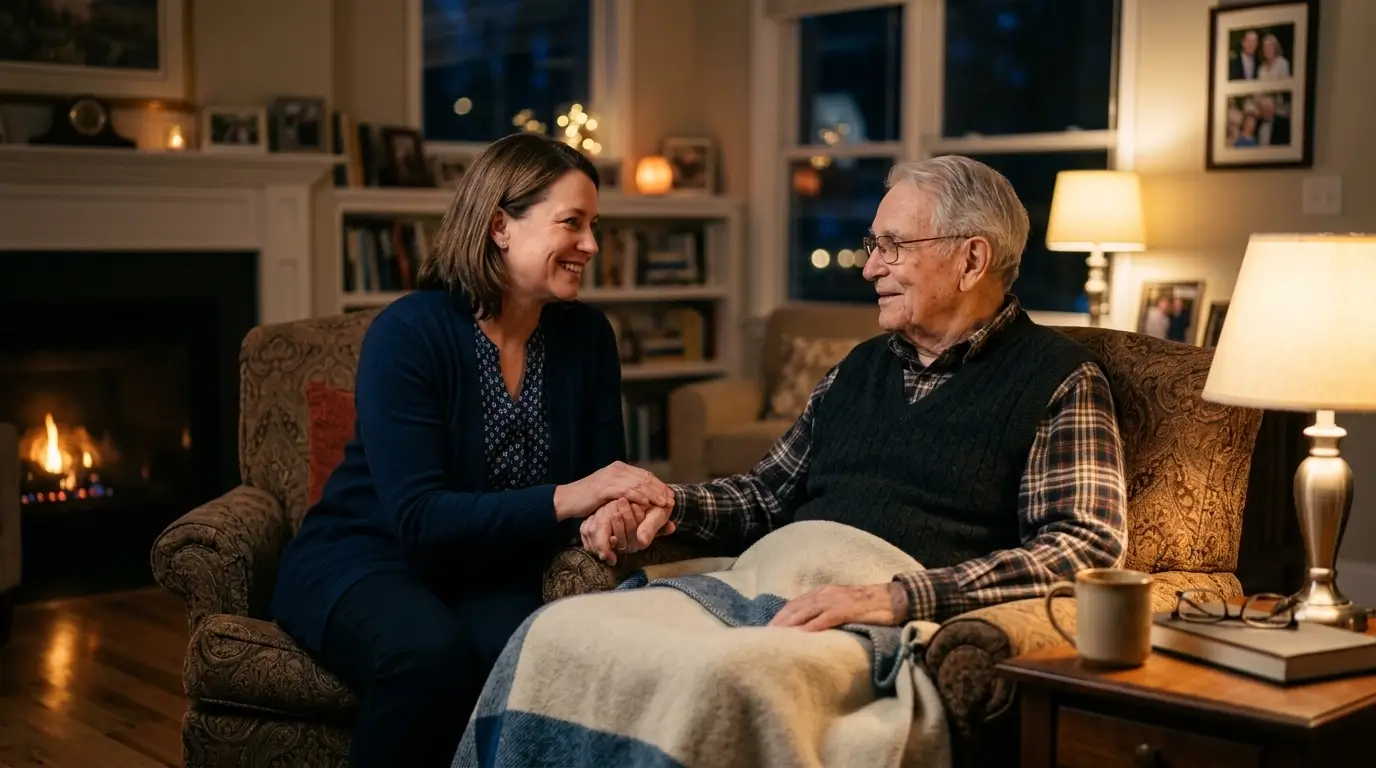
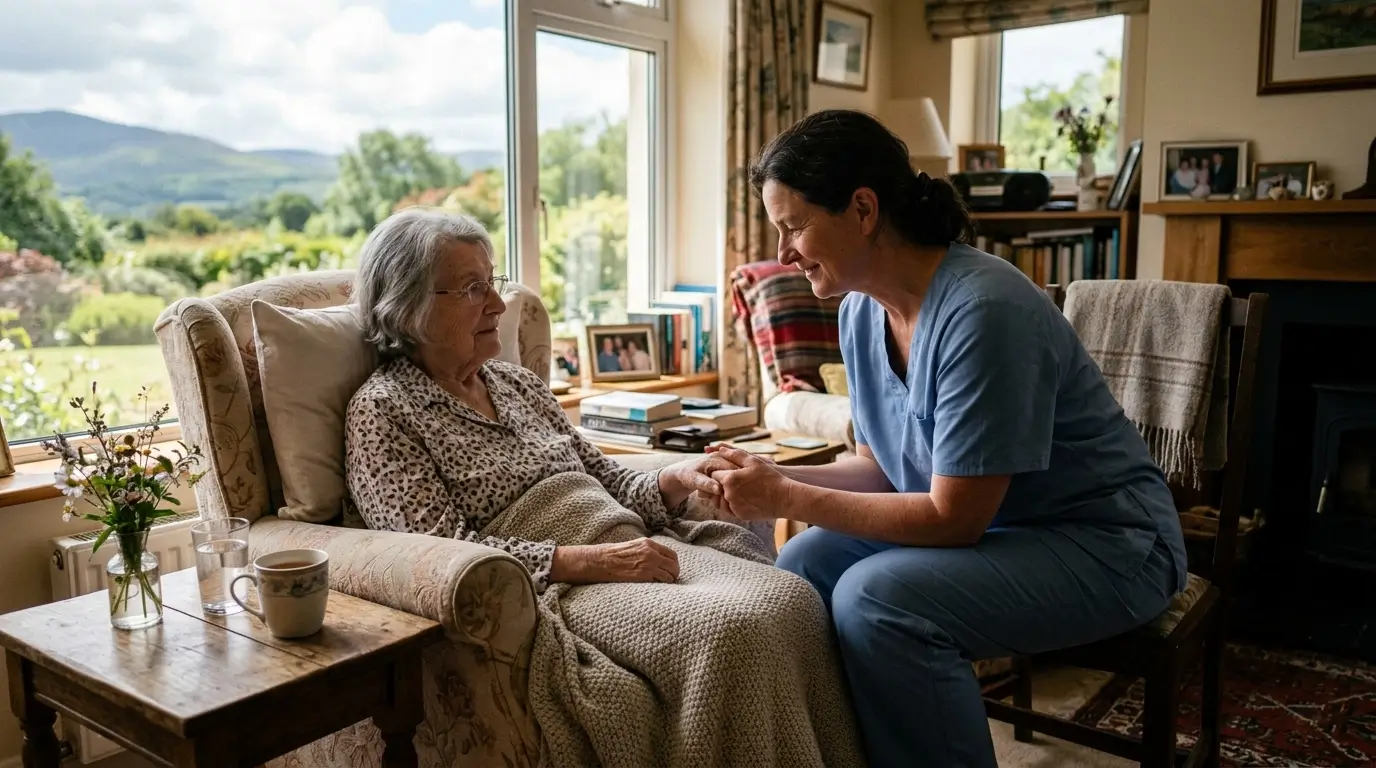
A palliative caregiver sits with someone. Not while doing something else. Just sits.
They read aloud. They listen to the same story about 1962 for the fourth time, with real interest. They hold a hand. They play music from someone’s twenties. They watch the birds at the feeder together and say nothing at all.
For a person in the later stages of a serious illness, the fear of being alone is often larger than the fear of the illness itself. A caregiver’s presence answers that fear in a way nothing else does.
They also make sure the person is not isolated from the world. Reading cards aloud. Helping with a phone call to a brother in Winnipeg. Describing what is happening outside the window. Our article on combating senior loneliness explores why this matters so deeply for older adults.
Keeping the household running
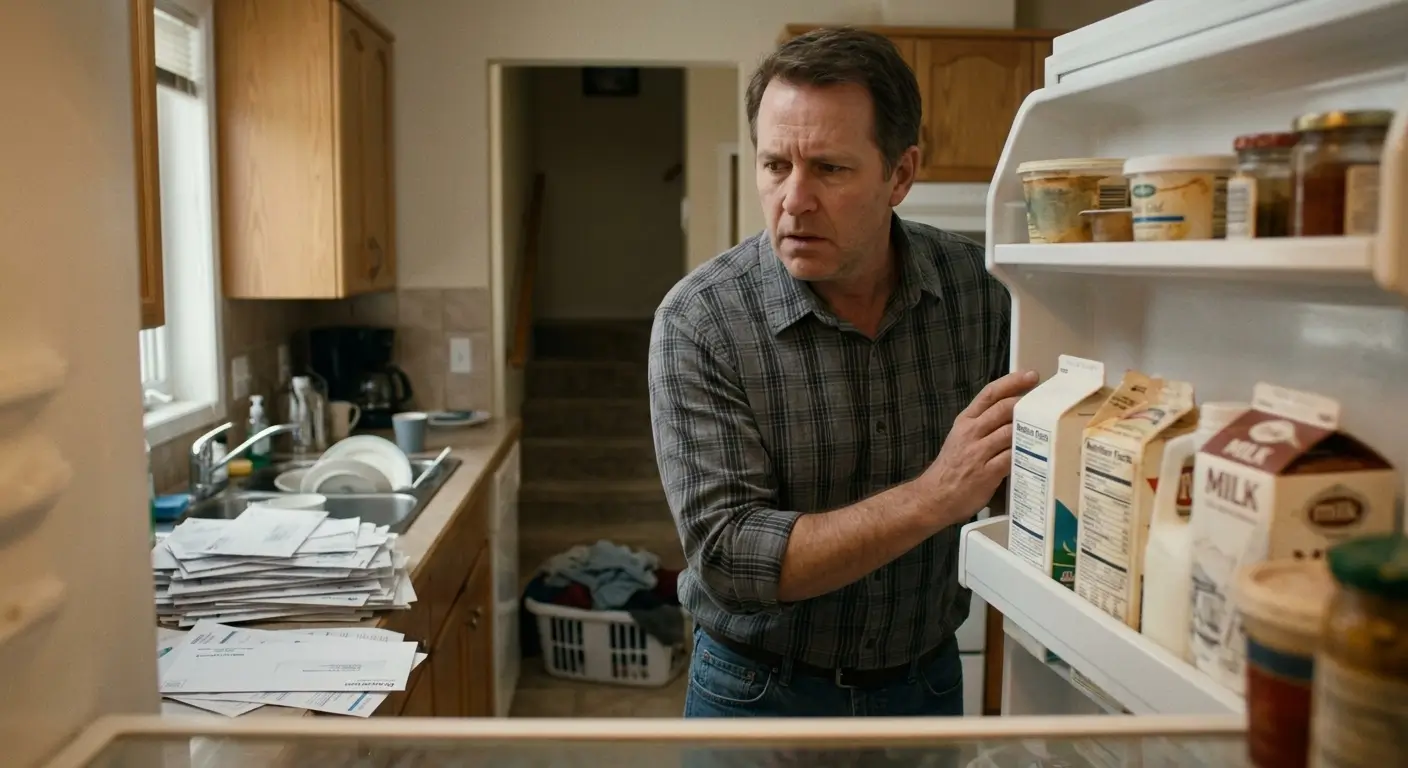
During a serious illness, the ordinary machinery of a house quietly falls apart.
Laundry accumulates. Dishes sit. The fridge fills with food nobody has energy to cook. Bed linens need changing more often than usual. The bathroom needs cleaning more thoroughly than usual.
A caregiver handles this. Not as a housekeeper, but as someone maintaining the environment that the person is living in and that the family is trying to function in.
This work matters more than it sounds. A family that walks into a calm, clean, orderly home has a different experience than a family that walks into chaos on top of grief. Our homemaking support covers this side of care.
Supporting the family, not just the patient
Something families often do not realize until it happens: a good palliative caregiver is supporting the whole household, not one person in it.
They give the primary family caregiver permission to leave the house. To sleep through a night. To attend their own doctor’s appointment. To go to their child’s hockey game without guilt.
This is respite care in its most essential form, and during palliative care it is often the difference between a family that makes it through intact and a family that breaks under the weight. Our article on caregiver burnout in Calgary covers the warning signs families often miss in themselves.
Caregivers also serve as a steady, calm presence for family members who are frightened. They answer questions honestly. They normalize what is happening. They have been in this situation before, and that experience is quietly reassuring to people who have not.
What a day might actually look like
Every situation is different, but here is a realistic picture of a daytime shift.
Morning. Arrive, greet, check in on how the night went. Assist with washing, oral care, and dressing at whatever pace the person can manage. Reposition. Prepare a light breakfast and encourage fluids. Tidy the bedroom and change linens if needed.
Mid-morning. Medication reminder within scope. A short walk to the living room chair if mobility allows, or repositioning if not. Open the curtains. Some quiet conversation, some silence. Perhaps reading aloud, or music.
Midday. Prepare and serve a small lunch. Encourage fluids again. Handle a load of laundry while remaining nearby. Wash up the kitchen.
Afternoon. Rest period. The caregiver stays present and available, checking regularly without disturbing. Perhaps a visit from family, which the caregiver supports by giving them space while remaining nearby.
Late afternoon. Repositioning. A snack and fluids. Prepare something for the family’s evening meal if that is part of the plan. Tidy the main living areas so the evening feels calm.
End of shift. Handover to the family or the overnight caregiver. Notes on how the day went, what was eaten, how pain seemed, anything that changed.
Nothing on that list is remarkable. Together, it is the difference between a family managing and a family drowning.
What a palliative caregiver does not do
Clarity here prevents disappointment later.
A caregiver does not make clinical decisions. They do not adjust medication doses. They do not perform nursing procedures outside their training and scope. They do not diagnose. They do not provide the medical palliative care itself.
What they do is everything around it, so that the medical team can focus on the medical side and the family can focus on being family.
Frequently asked questions
Is a palliative caregiver the same as a palliative nurse?
No. A palliative nurse provides clinical care including symptom management, wound care, and medication administration within their nursing scope. An in-home caregiver provides personal care, comfort, household support, and companionship. Many Calgary families have both, working alongside each other in the same home.
Can a caregiver be with my parent overnight?
Yes. Overnight and 24-hour arrangements are common during palliative care, and are often what allows a family to keep their loved one at home rather than moving them elsewhere. Overnight support also gives the primary family caregiver a chance to sleep properly, which matters more than most families realize.
How do we know if we need in-home care alongside the palliative team?
If the family caregiver is exhausted, if personal care has become difficult or uncomfortable to provide, if someone cannot safely be left alone, or if the household has stopped functioning, in-home support is likely to help. Many families wait longer than they needed to, and later say they wish they had asked sooner.
Will the same caregiver come every time?
This varies by agency and is worth asking directly. Continuity matters enormously during palliative care, both for the person receiving care and for the family. A good agency will work to assign one or two consistent caregivers rather than rotating a large number of people through the home.
What if my parent does not want a stranger in the house?
This is very common, and it usually softens once a relationship forms. The transition is easier when the first visits are short, when the caregiver is introduced as help for the family rather than help for the parent, and when the parent has some say in the arrangement. Our article on when your parent refuses help covers approaches that work.
Can in-home care start before the final stage?
Yes, and starting earlier is usually better. In-home support can begin at any point during a serious illness, not only in the final weeks. Families who start earlier tend to have a smoother experience, because the caregiver already knows the person, the home, and the routine before things become more difficult.
The work is ordinary, and that is the point
What a palliative caregiver does at home is not dramatic. It is a bath given gently. A pillow moved. A meal that goes down easily. A hand held during a hard afternoon. A load of laundry. A daughter who gets to sleep for six uninterrupted hours.
None of it makes for a compelling job description. All of it is what allows a Calgary family to keep their loved one at home, comfortable and surrounded by the people and things they know.
If you would like to talk about what in-home support could look like for your family during this season, the Compassion Senior Care team is here. You can learn more on our services page, or reach out whenever you are ready. We work alongside your medical palliative team, not in place of it.